Anti-Blackrooms

In a white supremacist society, whiteness is unmarked, the default category of the human. To be white is to be a subject, a citizen, a member of society; to be non-white is to need to constantly prove your social belonging. But to have full personhood you must be white.
Inconveniently for such a society, whiteness does not and cannot refer to or reflect a historically bounded national or ethnic identity. The borders and boundaries of whiteness are necessarily capacious, changing and shifting to include or exclude as necessitated by the political and economic dictates of the day. (Greeks, Jews, Germans, Czechs, Poles, Italians, Irish, Swedes were non-white peoples in the US, some as recently as the 1920s).
Nevertheless, in order for whiteness to be respected by judges, employers, police and other citizens reflexively, there needs to be a mechanism for recognizing it. Whiteness, invented to justify the domination and ownership of Black people, claims that race is a simple reflection of physical characteristics, a visual regime. It claims, in every historical moment, to be able to recognize the white, the non-white, and the Black almost instantly. "You know it when you see it."
But this rhetorical reliance on visuality, though extremely efficient for distributing the rewards, affordances, and violences of racial hierarchy at a glance, also produces a fundamental contradiction. To be white is to be unmarked, but who is white changes with time, and whiteness must be easily recognized by the millions of its agents on the ground in order to function – it must have some kind of marker. And skin tone is not sufficient. This contradiction produces a deep instability and anxiety at the very heart of the white regime.
Fear of miscegenation and immigration reflects, among other things, the knowledge that the regime of visuality is partial, that your eyes can be "tricked", that folks of African descent might "pass". However, to justify itself and to produce and recruit sufficient workers, consumers and soldiers the regime declares that "all men are created equal", which, combined with the moving target of whiteness, means the very rhetoric of the unmarked universal subject – the inalienable rights of all people – can be leveraged in struggle by those it is meant to exclude.
These struggles mean the white regime must constantly give concessions in order to stabilize its hold on the territory. The most consistently effective strategy to maintain the white supremacist order while containing struggles from below has been to obscure and mystify the processes of racial domination, expressed best through the official "colorblindness" of the law, the state and the economy, to hide racial difference behind criminal codes, bureaucratic redlines, highway bypasses, prison walls. More explicitly racial narratives of state (slavery, Jim Crow) have led to uprisings, wars and near-revolutions that have almost destroyed the entire white project.
White anxiety over the contradiction between an immediately visible racial order and a "colorblind" universalizing discourse of power and legality metastizes into a broad and generalized paranoia about ambiguity itself; white fear is at the heart of Richard Hofstadter's paranoid style. The white person grows obsessed and terrified by the fact that things are not what they seem on their surface: a mixed-race child, a secret jew, a hidden communist, a trans person's incongruous genitals, a conspiratorial invisible cabal that actually runs things, a vaccine which cures despite infecting, or a work of abstract art that causes emotions that can't be pegged to an obvious referent. Anything that threatens visual literalism becomes a threat to the very pillars of white civilization.
After a found-footage prologue, a first-person action sequence of some kind of corporate flack investigating an iconic creepy series of empty rooms and hallways, the main narrative of Backrooms (2026) begins on a shot of a young white girl pressing her hand into wet cement. We quickly see this is a memory, as, back in the present, it is clear that little girl was our protagonist, Mary, played by art house star Renata Reinsve, now an adult, is watching construction workers demolish her childhood home. She manages to keep the small piece of concrete that contains her handprint, which is going to be a crucial object later.
In voice over, we hear her first dialogue over a montage of establishing shots:
"We all have our loops, our habits, behaviors that keep us walking in circles, reaching for the same solutions over and over again, thinking each time they'll take you somewhere new. But they don't. And still, it's the neural pathway of least resistance. A path you made. It's the one that kept you safe when you were a child. You learned to push people away before they could hurt you, and now, as an adult, you're still stuck right where you started. Alone."
Mary is a therapist, and she's giving this speech to strip-mall furniture store owner Clark (Chiwetel Ejiofor) in a session. This is some extremely on the nose basic-ass psychological theory being offered as a thesis statement for the movie. It turns out however that this isn't just a starting point, but a quite direct description of what the titular backrooms are. Not only will you walk in circles through them: The backrooms are, at least in the movie version, a physical manifestation of the unconscious.
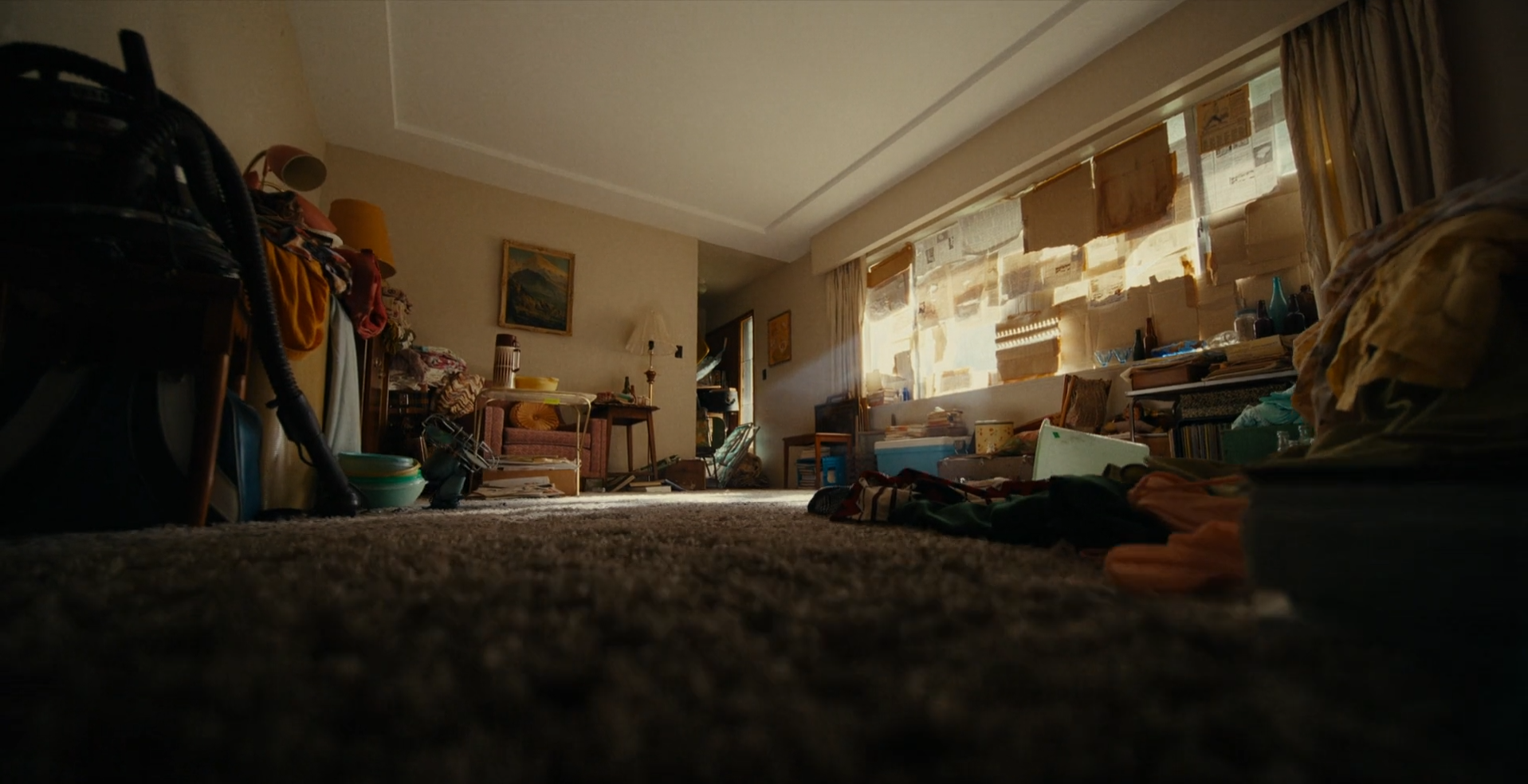
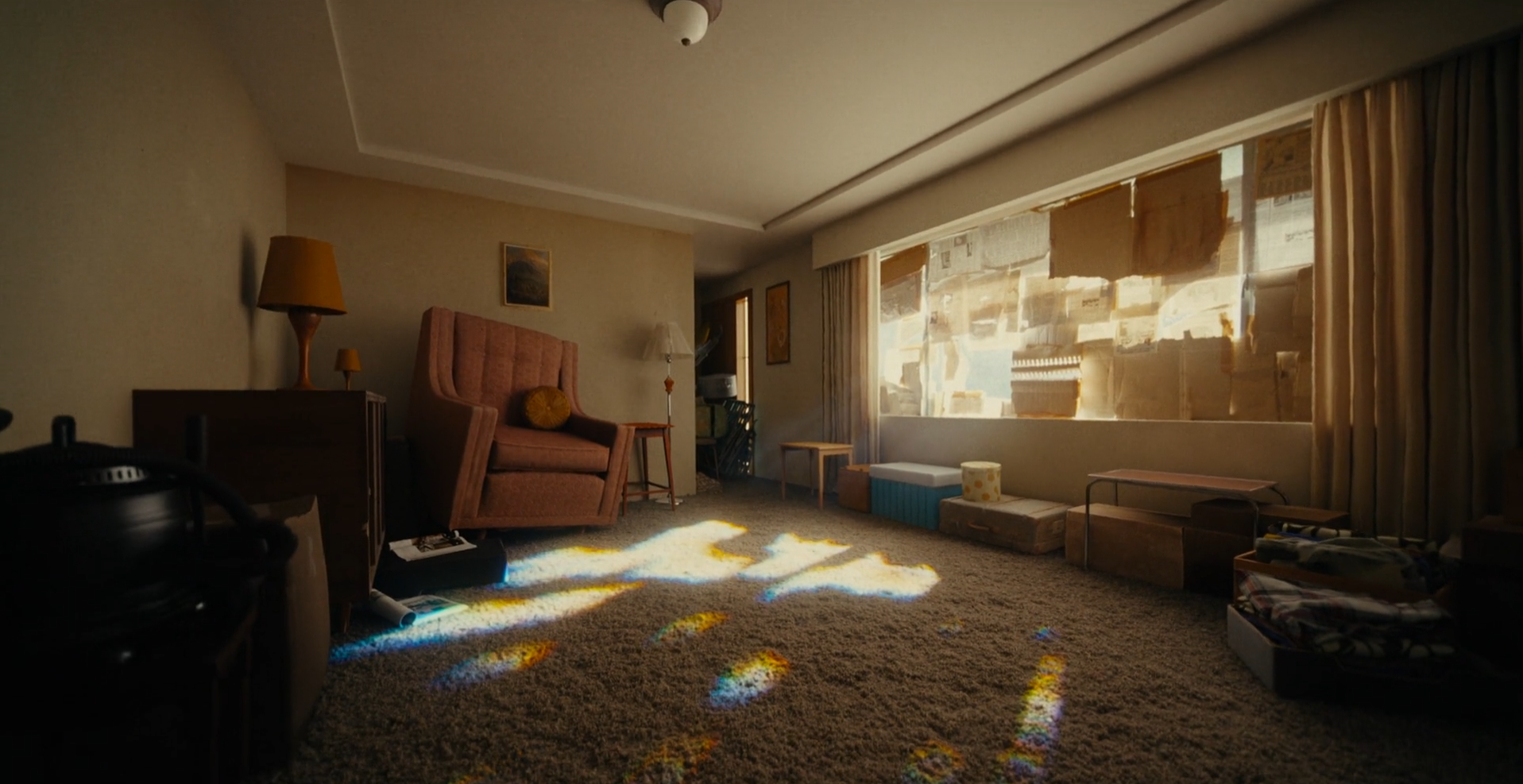
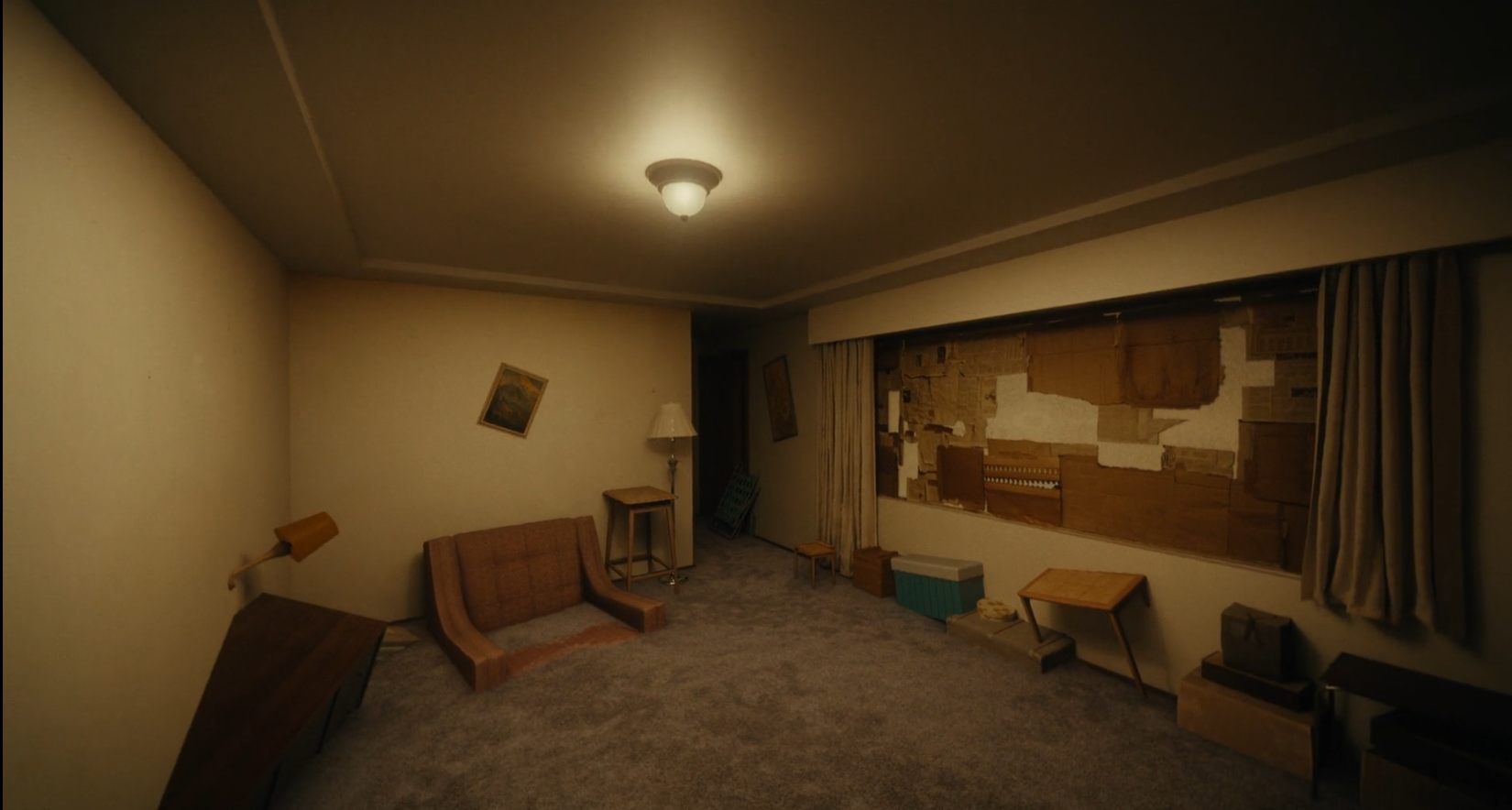
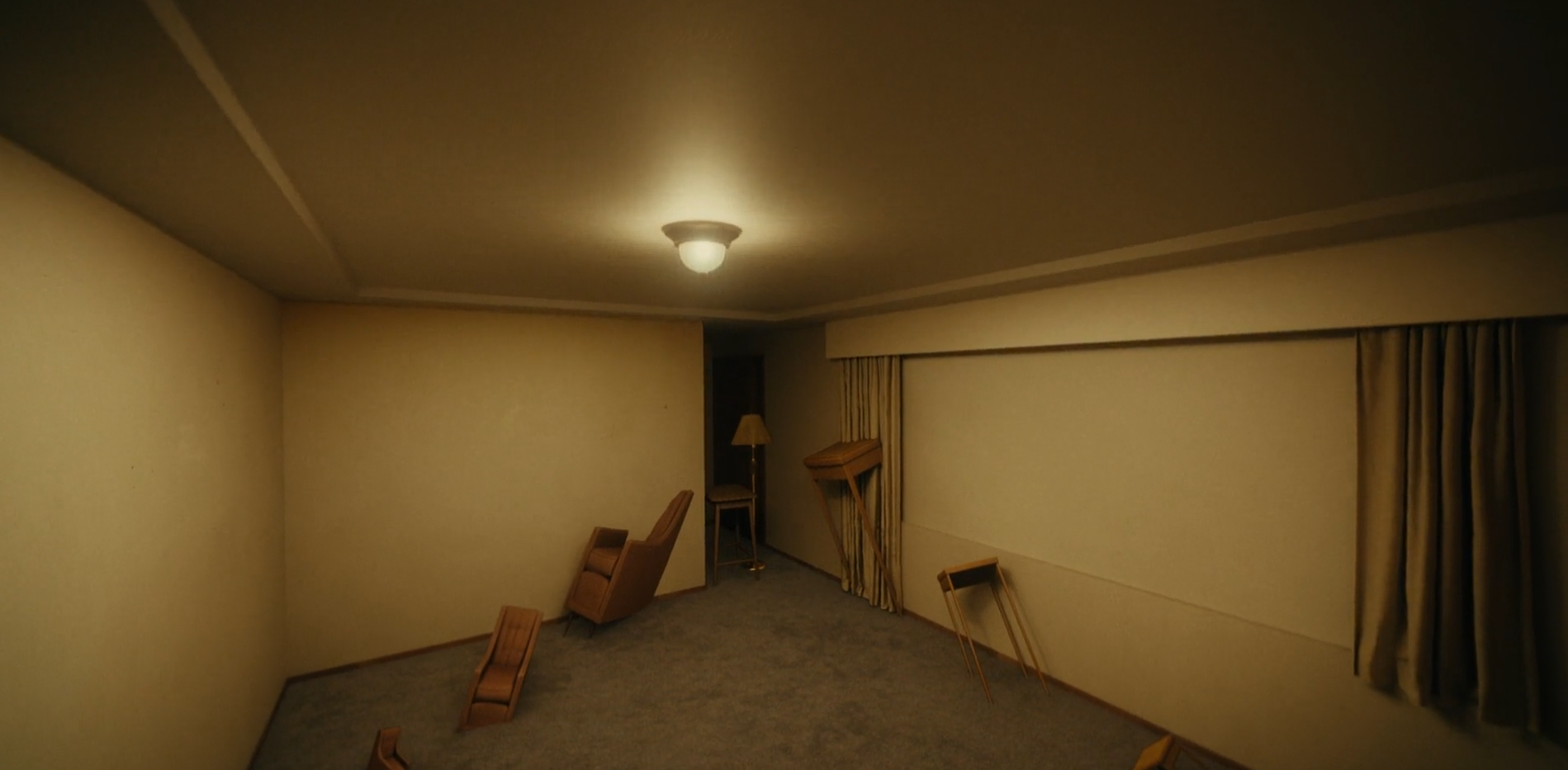
In one long shot in the middle of the film, we see Mary's childhood living room from a traumatic memory: she sits huddled in the corner, and the camera cuts into her point-of-view as she looks at the room. Suddenly, the camera cranes downward, through the floor, revealing another version of Mary's childhood living room, then another, each more degraded, more empty, with the furniture melting into the ground, shrinking, transforming or going askew. The further down into the memory/unconscious/backrooms you go, the deeper and more abstracted and vague become.
Clark, who dreamt of being an architect, is recently divorced. His wife left him because of his drinking, which he claims he had to do because of the stress of his business, which he only took on to support their family in the first place. He is angry, sad, and deeply lonely, and sleeps in the furniture store many nights.
One such night he discovers a way in to the supernatural backrooms in the basement of his store, which he can enter by walking through a wall.
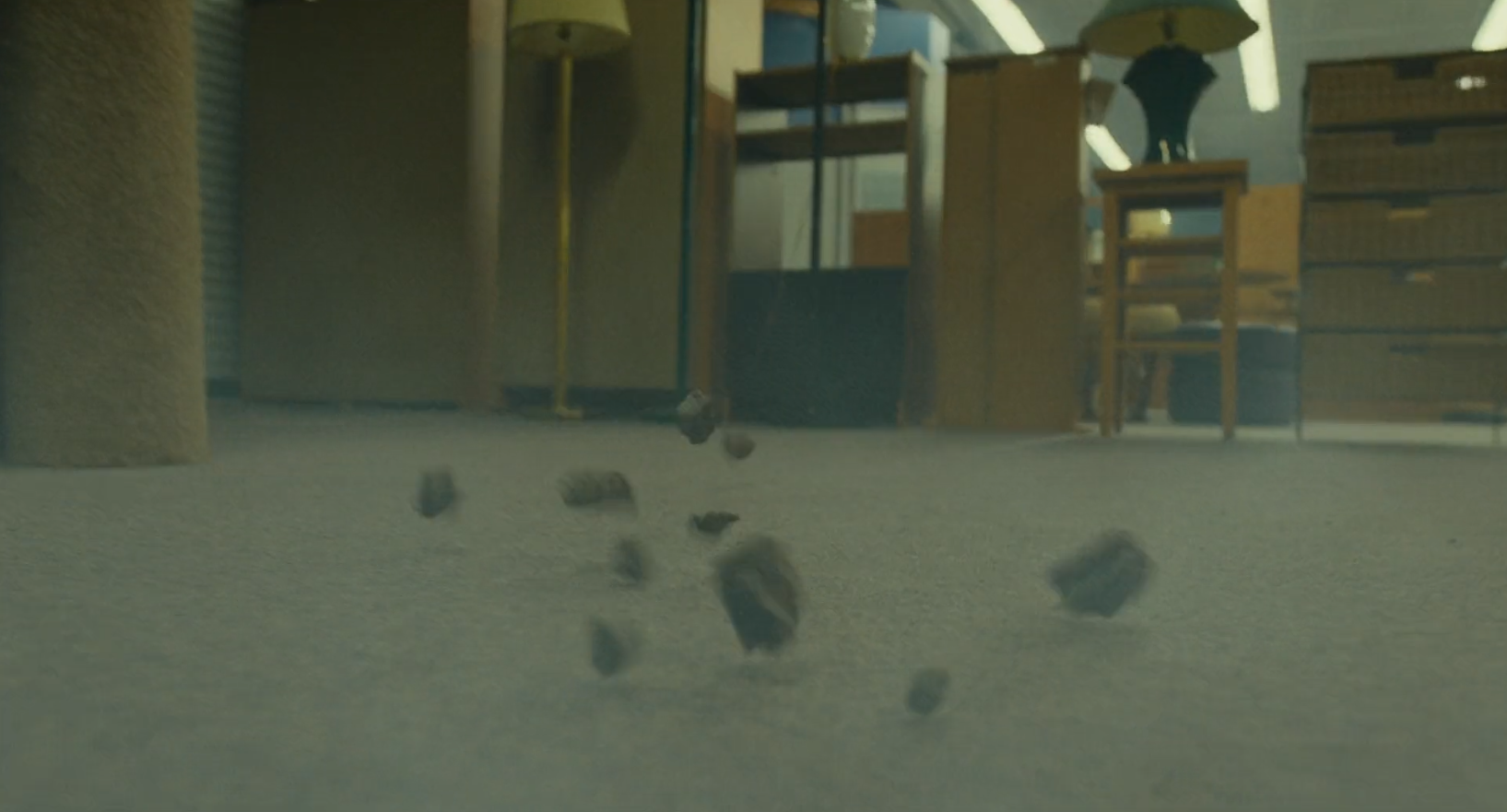
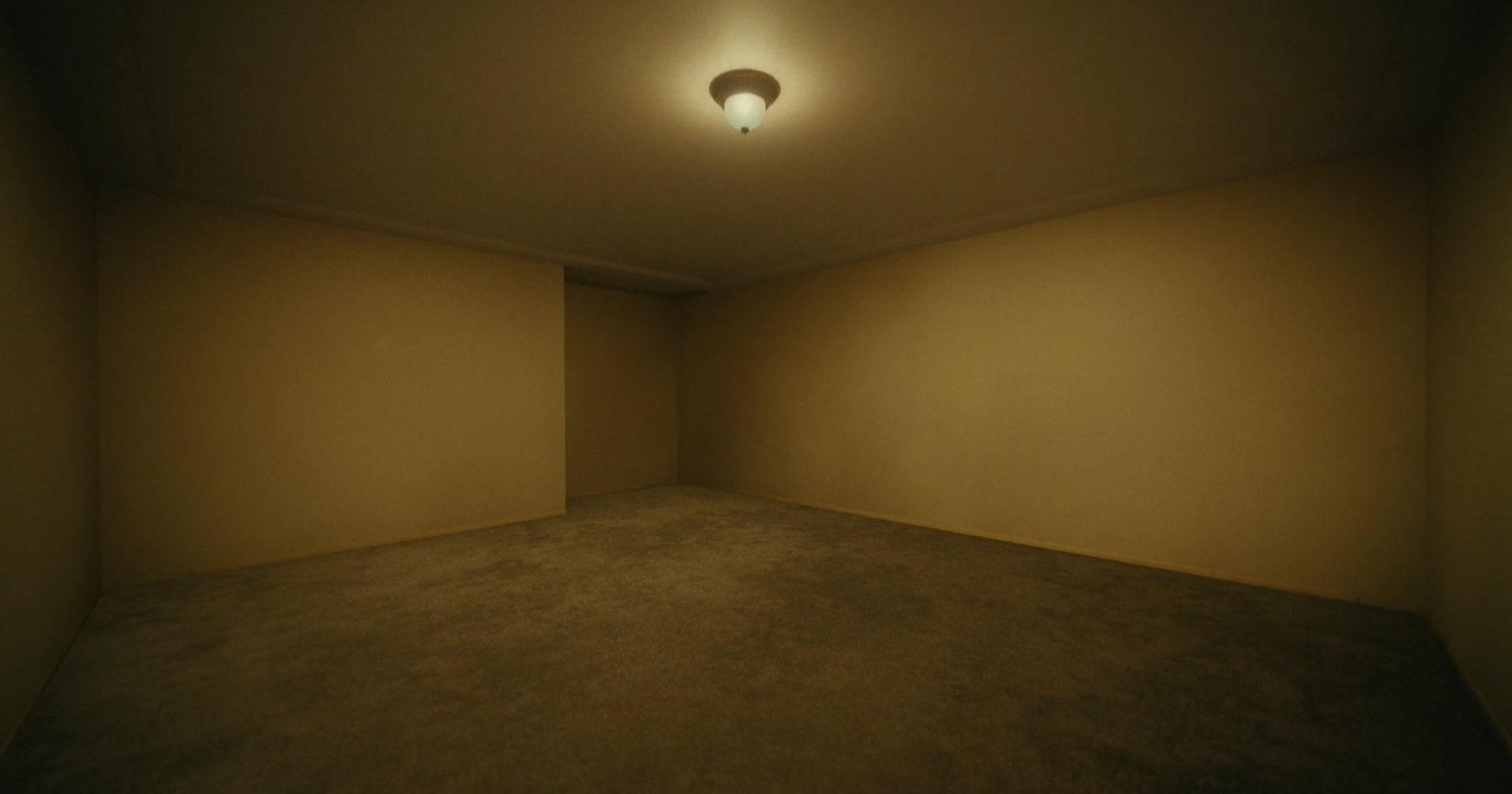
The backrooms are a piece of iconic internet imagery, endless carpeted hallways and rooms, with shitty drop ceilings, harsh yellow-white flourescent lighting, and pastel walls covered in faded cheap wallpaper, seeming to stretch on into infinity. For people who were workers or consumers in the 90s or early oughts, it looks like an exagerated style of certain workplaces, malls or office parks, a regurgitated version of a lost moment of corporate bland.
The backrooms are mostly empty, but contain furniture and other objects from the real world arranged bizarrely. Rooms will be bare except for an absurd number of chairs placed directly in the entryway, or a massive katamari pile of unusable furniture, much of it wrong, doubled or cut in half or unusably narrow or with no handles or base. Objects like signs or banners will appear, featuring language backwards, and things often seem to melt into the walls or floor, or drip down from the ceiling.
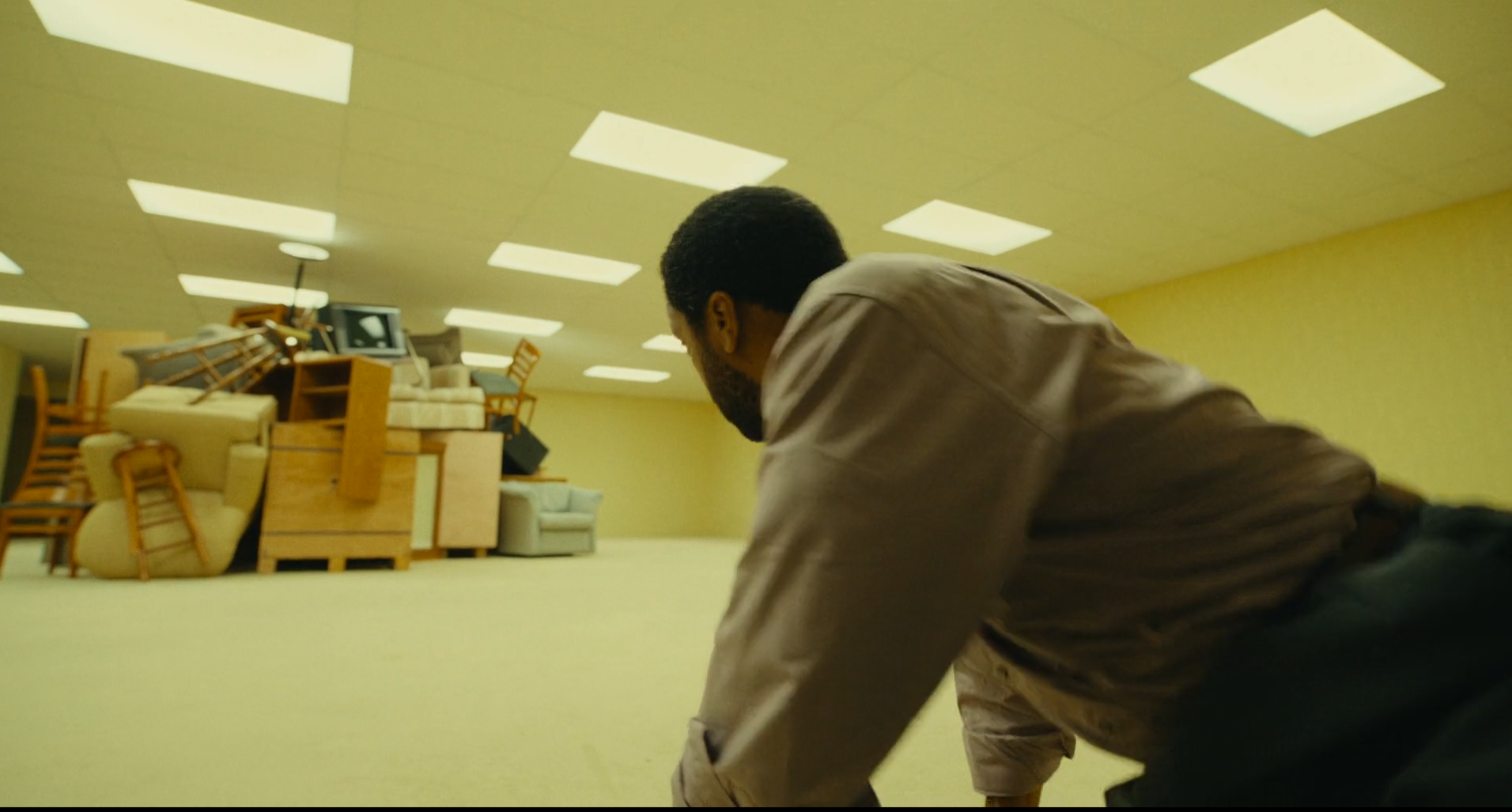
Rather than eerie, or "liminal" as they are so infamously analyzed, in the film version they struck me mostly as "incongruous". Random, weird, "wrong". At times it felt like an echo of Dali's (imo often trite and boring) dripping surrealist imagery, reprocessed through a century of intervening industrial design. Much like the surrealists, it seems an attempt to capture the unreal feeling of dreams, although here in high, bright full lighting. The surrealists attempted to paint with the unconscious, but the unconscious itself was a morally ambivalent space that revealed truths both horrific and beautiful. The backrooms, however, are a place purely of fear, violence and alienation.
Increasing this sense of incongruity is an extremely frustrating directorial style: every character is almost always centered in the dead middle of the widescreen, with camera movements mostly working to keep that character centered. Long duration, slightly low-angled medium and medium-long shots predominate. This framing tendency may be due to Parson's Youtube roots, but it also inevitably draws the mind toward Wes Anderson's fussy diorama box style. Where Anderson's domineering frames are drearily symmetrical, Parson's are askew, full of straight lines in the ceilings and walls that don't meet, or run at odd angles to the frame, with aforementioned random objects further breaking symmetry in the background. This architectural asymmetry contrasts with the monochromatic lighting and the character's symmetrical blocking to produce the film's stylistic affect. (As a result, the most dynamic part of the film by far is a first-person "found footage" style sequence towards the middle of the movie.)
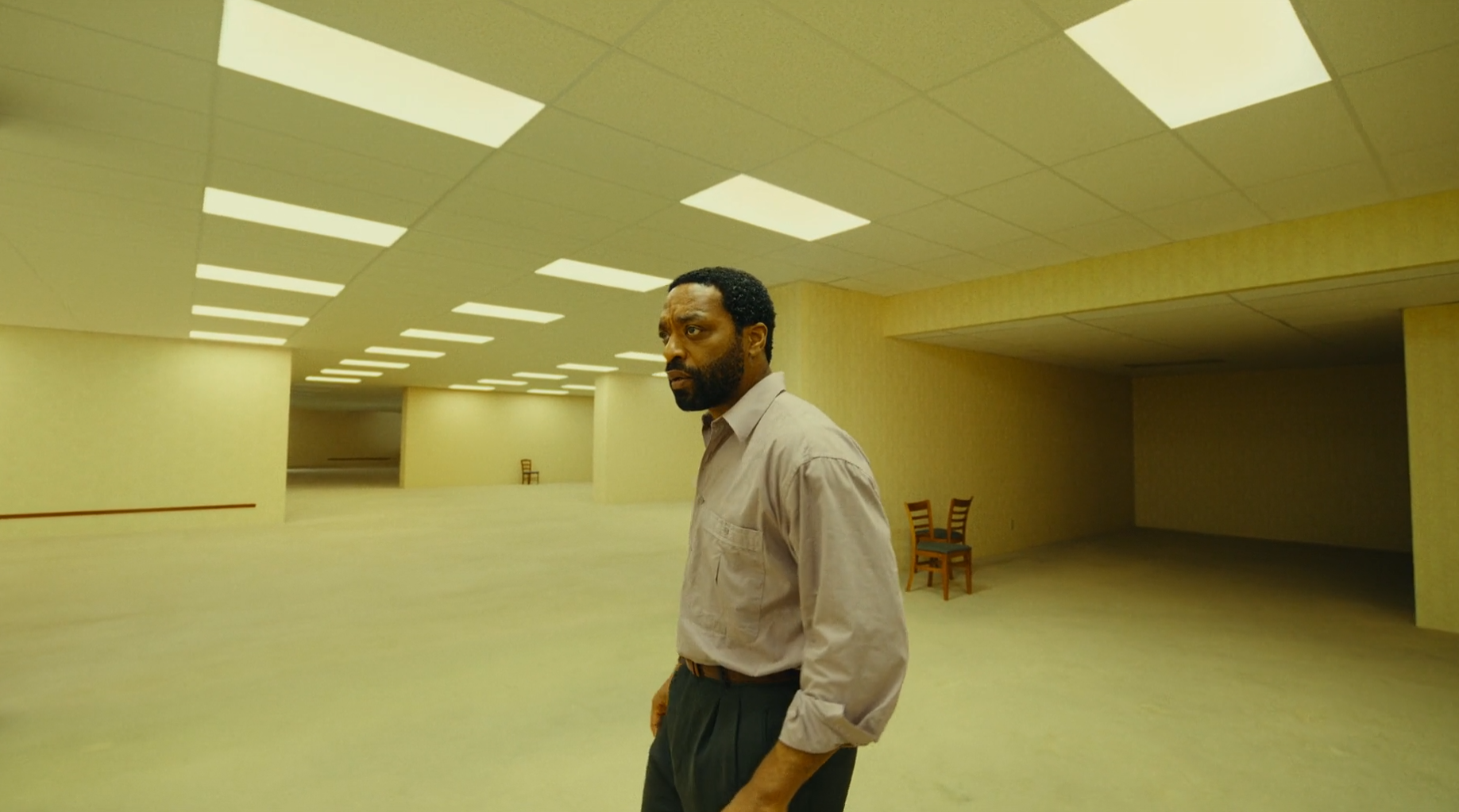
Intrigued and frightened, Clark begins spending more and more of his time exploring the backrooms, neglecting his business and even his therapeutic work, and as he does so his psyche begins to crumble. He tries to explain the backrooms to Mary, but she understandably doesn't believe him. Eventually we see him encounter some kind of monster, get attacked, and then he disappears entirely.
After a few weeks, Mary, worried about her disappeared client, goes to the furniture store to find him. She finds the entryway, goes into the backrooms, and begins to explore them herself. She soon finds Clark, who chokes her out, drags her somewhere deep into the backrooms, and ties her to a chair in a dining room he has assembled there. When she comes to there are also two monsters present, who look mostly like people but with incongrously repeating facial features, evoking the cubist compositing of images that are taken from multiple close but differing angles; what a face might look like if the brain didn't resolve motion into a unified whole but instead reproduced each separate image exactly.
They can't speak, although they can make strange guttural sounds. It turns out also that these beings don't feel pain, don't have blood, or muscles, or fat, but instead are full of a kind of blubbery like flesh that Clark can take and eat: he has been living off them for weeks down here. They are bodies without organs; they are half-forgotten memories made flesh.
Clark, after some further displays of grisly dismemberment, makes Mary join him in re-enacting the fight with his ex-wife that lead to their divorce. We saw Clark and Mary do this exercise once before in Mary's office, an exercise that seems to have triggered his descent into madness, and here it is terrifying, uncanny and miserable. With Mary tied to her chair at the head of a cannibal's parody of a family meal, screaming in horror, this is an absolutely unearned reference to the climactic dinner scene of Texas Chainsaw Massacre.
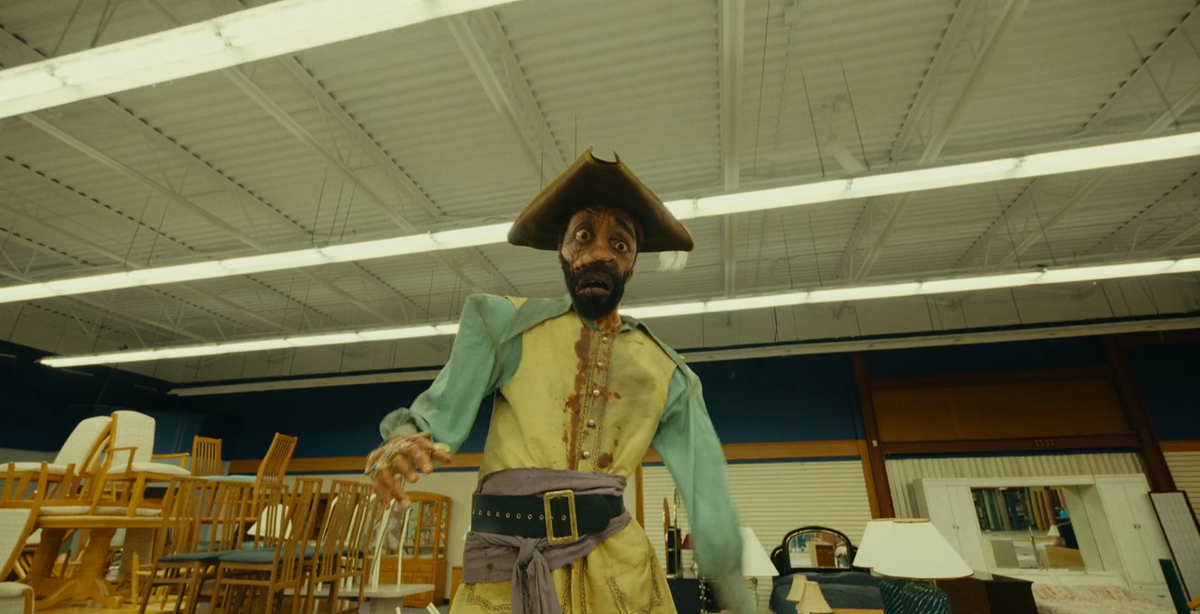
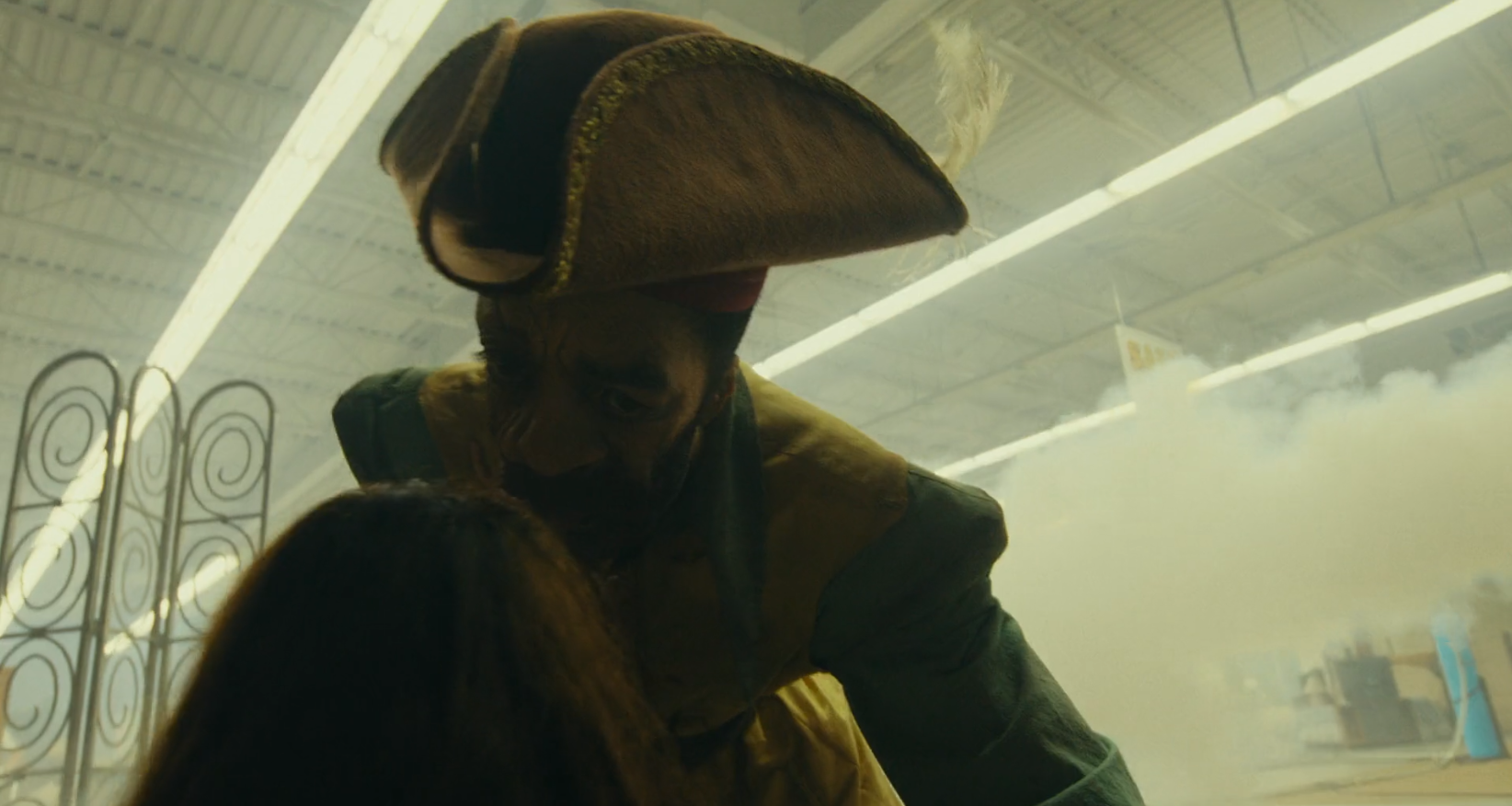
But then the monster arrives. The monster is an eight or nine foot tall version of Clark, deformed with bulging eyes, huge flaring nostrils and strange facial scarring. Also unable to speak, he instead grunts and roars. He is peg-legged, in a pirate outfit (the pirate is the advertising mascot of Clark's furniture store) and represents Clark's fear of what he is becoming, or, perhaps, the monster that Clark fears he truly is. Captain Clark (as he is referred to in fan discourse) is Clark's id. Clark tries to talk to him and calm him down, but he bites Clark's throat out, and the rest of the action of the film is Mary fleeing this monstrous pirate captain through the backrooms toward the surface.
At one point, when she has almost escaped – we know this because she is in a version of Clark's furniture store that almost looks like the real one – as she flees upwards, spaces become less degraded, incongruous and bizarre, becoming more true-to-memory – she is cornered by the monster. She knocks out the peg-leg, flees further, and collapses injured on the ground. In a jump scare, Captain Clark reappears crawling up behind her and mounts on top of her in a clear evocation of racialized sexual menace that could come straight out of Birth of a Nation.
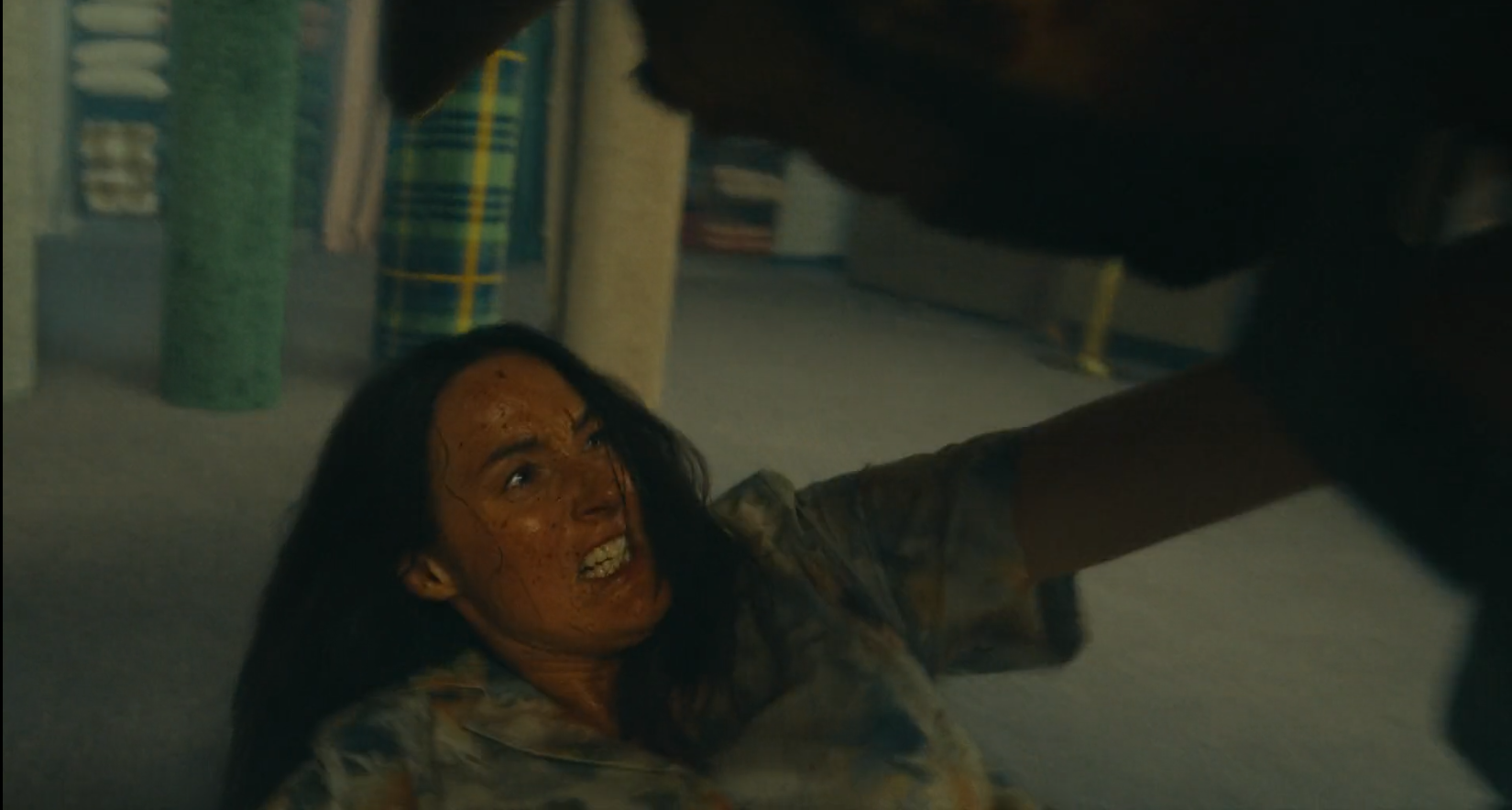
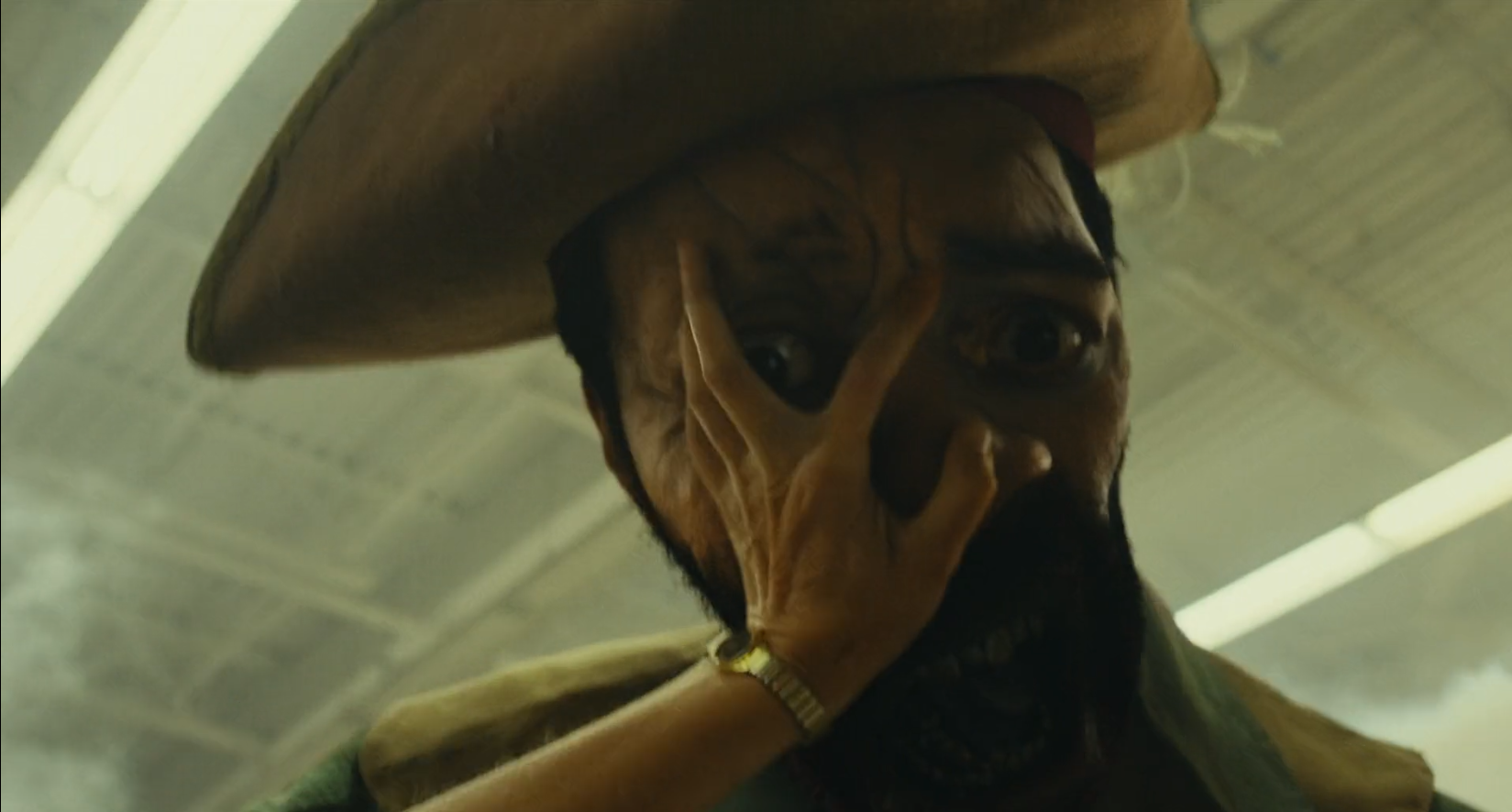
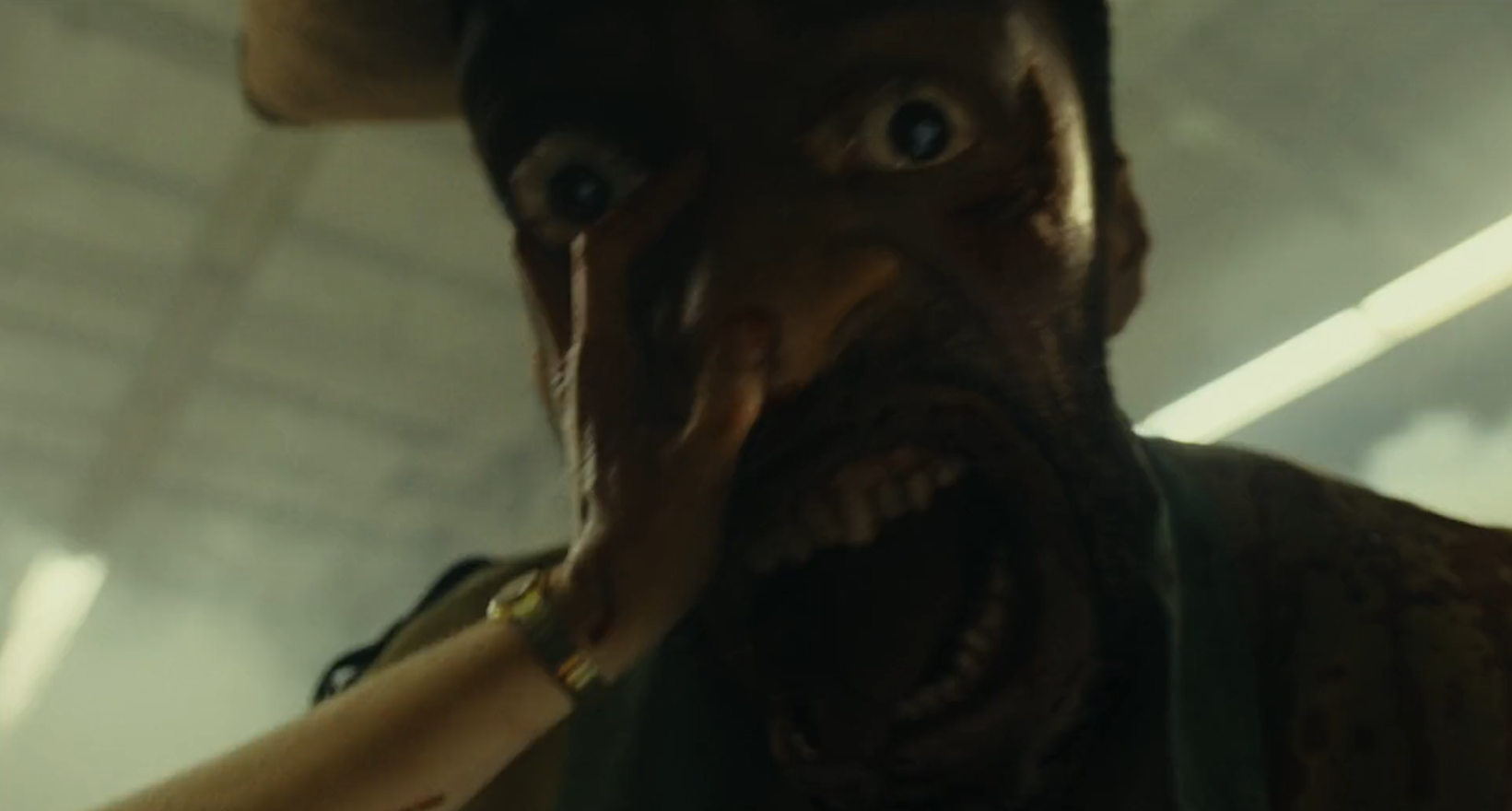
But luckily, she remembers, she has the piece of concrete in her pocket – the image of her troubled white girlhood that we have seen her gazing at again and again – and she uses it to bash the Black brute's skull in. The last blow shatters the piece of concrete into rubble. Finally, she can let go of her childhood trauma.