The Breakup Theory Episode 32 - Opening Up the Personal Essay (Trans Style) With Megan Milks
Today I talk with the great writer and friend Megan Milks about their new essay collection Mega Milk, published by Feminist Press. Megan explores milk both literal and metaphorical toward questions of names, transition, family history, nourishment, animals, agriculture, business, and land.

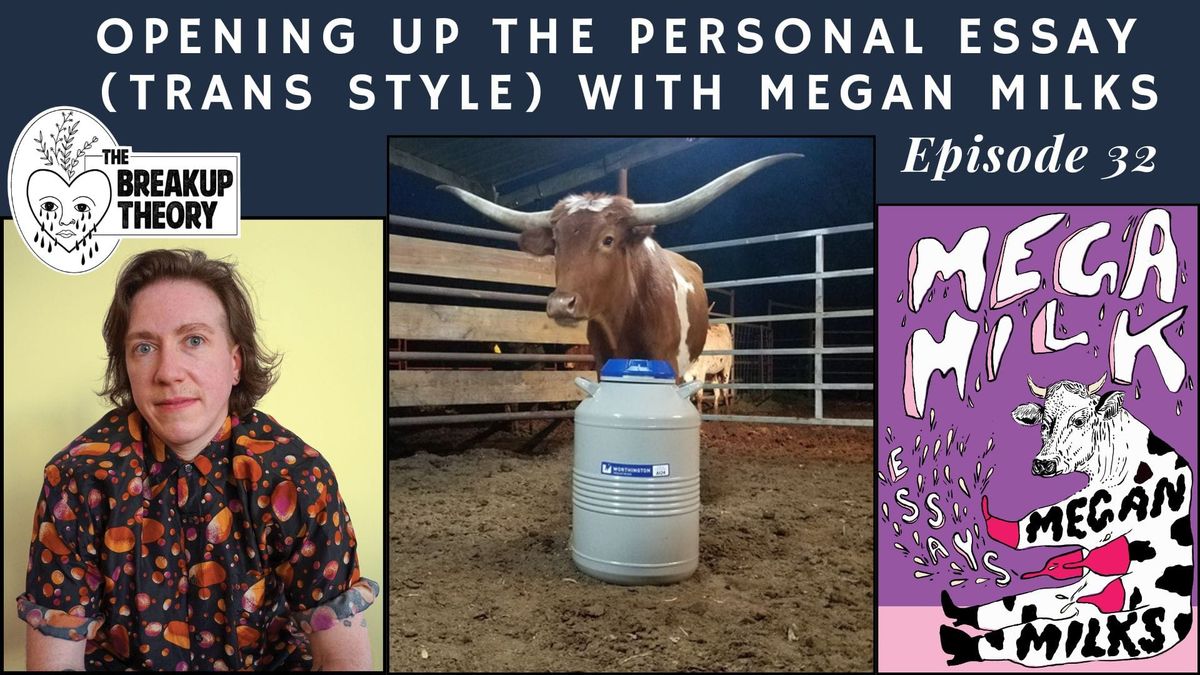
Today I talk with the great writer and friend Megan Milks about their new essay collection Mega Milk, published this year by Feminist Press. I just have to say that Mega Milk by Megan Milks is maybe the best title/author combo that will ever exist. But beyond that amazingness, Megan’s book contains many paths of exploration through milk both literal and metaphorical toward questions of names, transition, family history and dynamics, nourishment, connection, and human relationships with animals, agriculture, business, and land. The book is vulnerable, freaky, kinky, funny, and informative, all at once.
As I say to Megan, I find the genre of the personal essay to be one of the most difficult types of writing to pull off well. You need to find something singular enough to make broad connection with an array of readers, and often the most successful type nestles such a memoir inside a tangential impersonal narrative based in research and fact. With a book, there is typically a thematic line (here, milk) that is able to hold the essays together loosely without strangling them. The key is for the writer to open the essay up to all of the contingent possibilities while still maintaining a formal hand to guide the reader. It is not a genre I have delved much into, stopping immediately at the vulnerability.
One of the most interesting things to me about the trans personal essay collection in particular is how it gets at transition askew. It is not a transition narrative, from A to B (the classic kind). Nor is it a realist stylization of trans experience. Where transition comes in, it is in pieces, resisting linear time, often becoming incidental to the thoughts, feelings, and research of the writer. And yet, transness is somehow always there. I think it is an exciting place for trans literature to go, navigating out of the genre stereotypes that congeal every half decade or so.
As with names, which Megan and I discuss, there is perhaps a kind of ambivalence towards the representation of transness. I bring up Ralph Ellison’s essay, “Hidden Name and Complex Fate,” which ruminates on his near namesake, Ralph Waldo Emerson, placing Ellison into a particular relationship to American literature, a burden of an inheritance to take on as he also aimed to escape the nightmare of history into invisibility. The name works retroactively, creating meaning where maybe there was none. This pertains too to the trans narrative, told retroactively often with an attempt to make it seem fated from the beginning. Megan’s name is not hidden, but they wrestle with its potential fatefulness, with transition coming in as a kind of freeing or loosening while still retaining that meaningful burden.
Okay, I’m getting all lit crit on you. And perhaps this veers away from Megan’s own thinking here. So I will let Megan talk for themself in our conversation.
But first, I can’t recommend this book enough, so pick it up at your favorite bookstore. Megan has two other books with Feminist Press, the novel, Maragaret and the Mystery of the Missing Body—which I loved so much as it plays with the kid detective genres of my childhood—and Slug, a collection of short stories. Get them all!
Megan is also out on book tour. If you listen to this when it comes out, you can still catch Megan in Chicago on April 10 at Women and Children First. Also 5/14 in Decatur, GA at Charis Books as part of Sam Ace's Meet Me There Series, with Mattilda Bernstein Sycamore (another beautiful writer). And 6/11 in Boston at the Model Cafe - T4T Reading Series.
You can follow Megan on Instagram @sklimnegam . Megan often offers workshops, which you can learn about there.
Before we get into the conversation, I’ll do my usual rundown of ways you can support this project.
If you like this podcast, please rate it and follow it on the different apps where you listen to it. That does help boost the potential audience. Also, tell your friends too! I love hearing from people about their thoughts—but as always any questions you might want us to tackle on the show. You can leave us a message at (917) 426-6548 or using the form https://form.jotform.com/thebreakuptheory/stories. Or find me on Instagram @thebreakuptheory and DM me.
I will be hosting a book club on our discord server April 22 at 5pm eastern on the anarcho-nihilist book Blessed is the Flame by Serafinski. Subscribe and join us, whether or not you read the book!
The Breakup Theory is a member of the Channel Zero Network of anarchist podcasts, which pulls together a wide variety of shows taking an anarchist perspective on culture, politics, actions, and more. Check them out at https://channelzeronetwork.com