The Christmas tree chipper at Prospect Park
The next day, the trees are gone, dismembered and shattered, like an old battleground littered with corpses blown to pieces from ordinance. But it is sap you smell not blood.

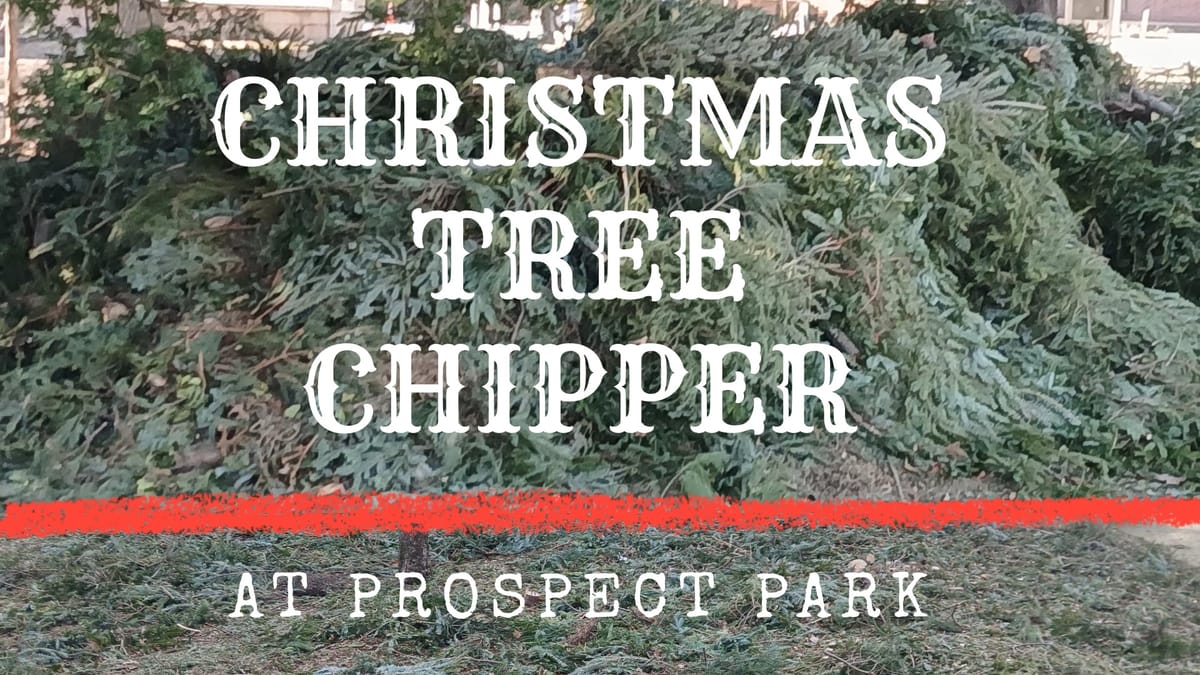
If Christmas can be redeemed, it’s in the scent that pervades the park in the month or two after the holiday. I have only ever seen the result, never seen the people carrying their finished trees to the corner of the park to discard them. My experience, then, is to stumble across the pile of trees that takes up the whole entryway on the southwest corner. And then the next day, the trees are gone, dismembered and shattered, like an old battleground littered with corpses blown to pieces from ordinance. But it is sap you smell not blood.
Before Christmas there are bundled up men selling trees on street corners, but I have never seen the people lugging them home, down the stairs to the subway, crossing the platform for a transfer. Or perhaps the people who buy trees afford taxis, ubers, chauffeurs.
Still I wonder, how do these trees even fit in a New York apartment? It’s that New York question of whom is that for? I walk the streets seeing so many things that are not for me, but I remain a witness to them and they exist as possibilities never reached—or even wanted. The shops in Soho, for example, those tiny boutiques that carry maybe twelve shirts and a selection of five handbags. I’ve never seen anyone inside. These spaces of unattainable consumption begin to swallow the whole city, so that rambling the streets feels like being in a rich person’s fairyland.
At what point is the city no longer for anyone? I wander the streets of New York, of London, of Paris, and I wonder: who lives here? who shops here? who can afford anything? how do I afford anything? I don’t feel like I sneak my life here, that I don’t belong. There are plenty of us, plenty worse off. But is the city for us? How do cities maintain a reputation when no one can make it? Why do we all flock here? It’s like the idea of a family, you work at it, you think you’re there, but you mind the gap between actuality and the ideal.
I like to imagine all the other city lives, the anonymity and the too-closeness. We know nothing and everything of each other. The streets spell possibility, mostly possibilities I don’t pursue. So I sit in my apartment thinking of all the things I could be doing rather than a crossword. But if I do make it outside to walk the streets alone, I remember that line, we are many, they are few.
Christmas is a widespread phenomenon, even if I don’t particularly partake. And so, to imagine the families (parents? with their small children?) marching their trees down to the park to be chipped up makes practical sense, but it also completely demystifies the holiday. Do the parents allow their kids to watch this dismemberment of their dreams? Is the chipping of a Christmas tree anything like the crucifixion of Christ? It’s one of the few provisions the city provides to anyone, to rid you of your holiday cheer, the potters’ field of hopes dashed because nothing received can meet the desire for surprise, nor the delight in giving.