The Straights Are Not OK

Obsession is a feel good story. Not the movie, no, the movie feels really bad. But the industry story around Obsession is that rare happy one. 26 year old writer/director/editor Curry Barker, a sketch comedy Youtuber, brought the film, made for $750,000, to TIFF (the Toronto International Film Festival), where it was the object of a fierce bidding war and sold to Focus Features for $12 million dollars. Released wide, it has so far grossed $125 million domestically in three weeks, and in its third week Obession outperformed the latest Star War in its second. And, forgive the cliche, the film is carried by an undeniably break-out performance from star Inde Navarette. Two careers born in one go, and a surprise success for an indie horror film the likes of which we haven't seen since A24 released The VVitch in 2015.
The re-emergence of indie-horror hit making, with A24 helmed creepy-pasta adaptation Backrooms reigning unstoppable at box office number one, has driven a flurry of attention and excitement which feels quite reminiscent of the emergence of the "elevated horror" subgenre in the second half of the 2010s. [I have a longer essay in the works about what is going on there, culturally, so watch this space lol.] And Obsession is what you might jokingly call a "rich text": there is a hell of a lot going on here, not all of it good, but all of it very interesting.
The film follows Baron "Bear" Bailey (Michael Johnson), a shy early twenty-something who has been long infatuated with friend and coworker Nikki (Inde Navarette), but has found it impossible to admit his feelings. The film opens on him admitting to the camera, and presumably to Nikki, how he feels – a moment of truly heartfelt sincerity and vulnerability – but the camera cuts to reveal that he is in fact just practicing with a waitress at a diner. His friend, Ian (Cooper Tomlinson), immediately ribs him for the openness and sincerity, instructing Bear to play it cool and neg her instead. Many of the movie's themes – masculinity, vulnerability, women's emotional labor (the waitress is curtly dismissed by Ian) – are framed neatly in a scene which also gives the audience space to like this thoughtful, vulnerable, lonely boy.
We then see Bear return home, where he finds his cat dead on the carpet, the cat somehow having gotten into a bottle of Oxy left behind by Bear's grandmother. Bear is truly and deeply in grief – this nod to both the opening of Midsommar and the opioid crisis further ground the film's intentions – and Johnson's excellent performance bring us into empathizing deeply with him.
I belabor this opening sequence because it reflects one of the most impressive and interesting things the film does. Where countless movies and TV shows have relied on the mere fact of someone being a perspectival character and/or protagonist to tell an anti-hero story, Obsession is showing us this boy's deep vulnerability, loneliness, and love the better to deconstruct his cruelty later on, and it does so in a few quick scenes. Indeed, it's quite possible to watch the movie without recognizing his cruelty and selfishness at all, as you could read the movie entirely through a more comfortable generic lens: the story of the Monkey's Paw. "Be careful what you wish for, it might come true".
After a night at Trivia with his friends, Bear drives Nikki home, and she gives him not one but two openings to admit his feelings – a woman must always manage and reflect the feelings and needs of the men in her life – and he both times refuses, cowardly, awkward, hesitant.
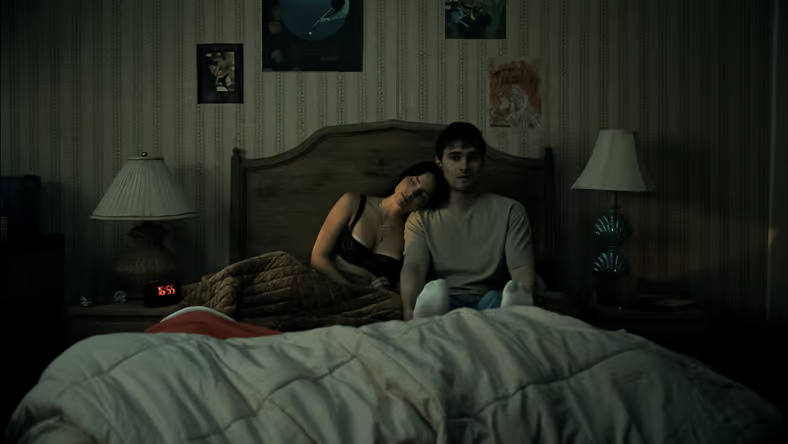
This remains sympathetic to some extent of course – he beats himself up for it, and many of us have had a crush on a friend we've refused to cop to. But then Bear makes a wish on a novetly "One Wish Willow" toy he picked up earlier, wishing that Nikki "love him more than anyone else in the world", and, well, it works. Immediately. She begins acting strangely, demanding to come home with him and sleep in his bed, then freaking out mid make-out and backing away in abject fear and terror.
I really like the phrasing of this wish. Wishing that she love him "more than anyone else in the world" means she also loves him more than she loves herself, it is an imagination of love which is not only hierarchically primary over other loves, but is directly in conflict with autonomy, with self-respect, with boundaries and even personhood of any kind. Which means she will do any amount of abject, self-harming, disgusting and nightmarish things to try and keep him with her – which, with crescendoing horror, we watch for the duration of the movie.
And the terrifying ways Nikki behaves – standing in a corner watching him sleep, forcing her face into a rictus smile, switching seamlessly from pleading insecurity to whining need to cooing love – are the center of the terror (which is to say, pleasure) of the film, and Navarette is rightly praised to the heavens for her work here. This movie is hers, and she gives an all-time horror performance. Apparently director Barker had them watch Possession (1981) as part of preparing, and usually when people compare their latest movie to that perfect film with its perfect performances from its stars, I wanna vomit. It is among the highest praise I can think of to say that Navarette comes by the comparison honestly.
But what is horrible about it isn't only the horrifying things she does, but the ways Bear accommodates them, chastises her and covers for her, but never actually intervenes very directly. Because, and this is the heart of the film's critique, he basically likes it, he likes being in relationship with her and having access to her body and her care, he likes her being obsessed with him, even if she seems basically possessed by a demon or a different version of herself and the things she does are scary, gross and horrible, not to mention they clearly bring her pain. He's named Baron, after all, and there's really only one gross boy named Baron most of us are familiar with in 2026.
As a commentary on possessive love, male entitlement, and the couple form this movie seems kind of brilliant. And it is genuinely scary and upsetting, with moments of really funny humor throughout. The problem is that the majority of the behaviors Nikki engages in, the very things that make the movie effective, scary and pleasurable, look as much like psychosis as anything else. The movie is, on one level, about how scary and dangerous mad people are.