Someone's knocking at your door
tl;dr: Action isn’t what you think, and the people who you wouldn’t think are doing it.
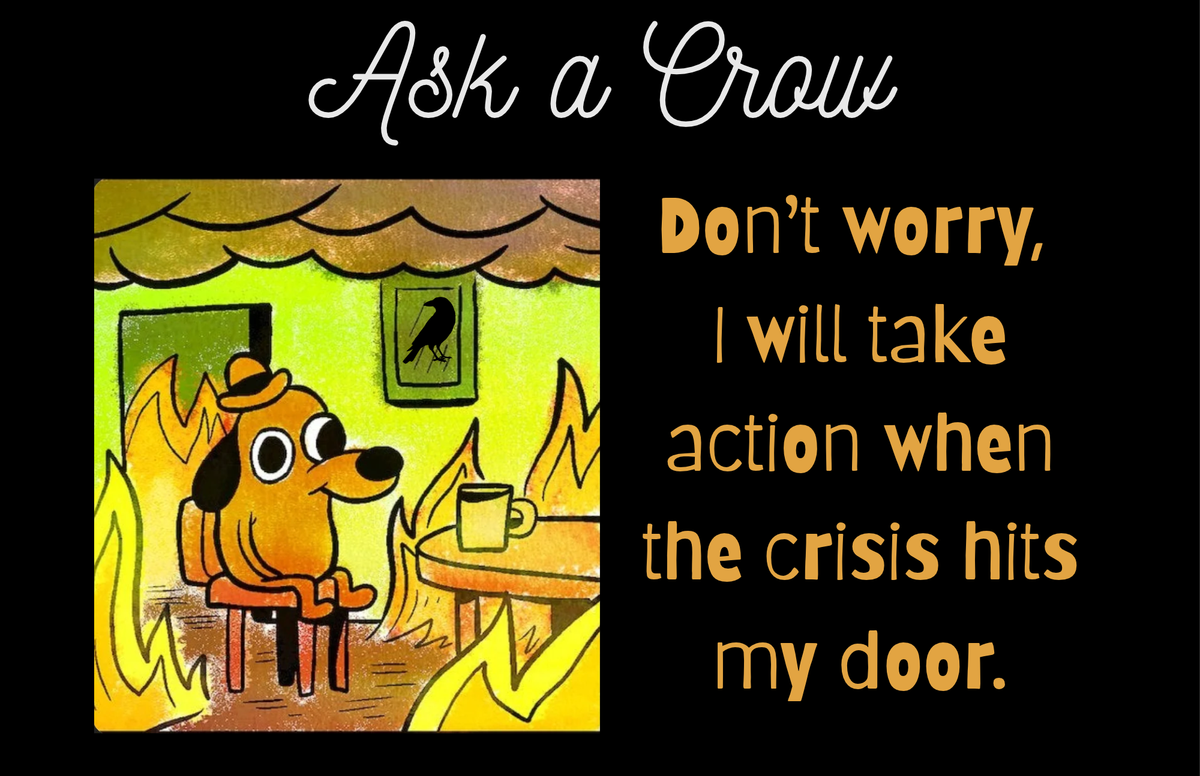
Question: Hey Crows, I am wondering if y’all have any ideas on how I can respond to someone who says: “ I will take action when the crisis hits my door.”
Dear wondering,
Oh yes, we’ve heard this phrase a lot, and it can feel annoying as fuck. Although, for some of us it can bubble up in our own thoughts, too… shit is hard and it's exhausting. You probably already did this, but asking what someone means by "action" is a good place to start. After all, there are many ways to take action and there are a lot of front lines, including the often less public ones like doing concrete care for a sick pal. Perhaps your friend is already taking action, as it were. Helping them see that might shift them in positive ways. Also, not everything is an emergency and oftentimes activists and organizers can over state the gravity of every situation. While this is true in many ways, it also needs some unpacking because on the one hand there is a lot of time and energy put into creating the fertile conditions for longer term mutuality and solidarity to take root (that less public stuff!). And on the other hand when a disaster strikes, especially spontaneously (like fires, floods, ICE), so do us humans. We always show up for each other!
But who is this we exactly?
Let’s get into this more….
First of all, the crisis is here. It’s been here. It just might not look like “Children of Men.” Yet.
Again, we totally get that folks are tired, and broke and may have a variety of physical, financial, and other barriers to be engaged with community right now. We really, really do get it. We at CAW have all been there. But we’ve also personally heard comments like this from non-marginalized, financially secure folks in good health with a lot of free time on their hands and it can be super frustrating and even feel quite dismissive.
What we’re seeing a lot of in projects like Adopt-A-Corner, Anti-ICE school patrols, outreach ahead of the latest climate catastrophes careening our way, etc, are the same folks showing up again and again. And again. And the majority of those folks are queer, trans, people of color, living with a variety of disabilities, working full time and still barely scraping by, single parenting and doing a variety of other unseen emotional labor/care work for family and friends.
So coming from that perspective and hearing folks with the means and abilities say they basically can’t be bothered to step in to build or strengthen mutual aid systems in their communities honestly just sucks. Also, in our experience, it is often these same people that tell their friends we are doing too much and that they’re worried we’ll burn out! This is not solidarity. It does not feel like the allyship that so many claim to offer. It says that it’s ok with them that marginalized folks are doing the work on their behalf while they just get to chill until the “real crisis” (aka excitement) starts and that it's ok if folks burn out. And, to add to the frustration, they step in when things are urgent and chaotic and expect folks to stop the hard work they’re doing and orient them, which in turn, takes time and energy away from the crisis time work. Or they step in and start suggesting changes to systems that everyone else built while they were off doing whatever one does when they can't be bothered while society is collapsing. See how annoying it is?
And here’s the thing: building strong webs of mutual aid–relationships with trust and connection and reciprocity and joy and care–IS the action we should be taking to soften the blow of the next crisis. Knowing where resources are (and maybe even gathering and distributing them) is important. Learning and sharing skills is important. Getting to know your neighborhood well—who needs what, where are the best routes out in case of emergency, who is the most vulnerable in your neighborhood—this is all so important.
Showing up in the boring times, repeatedly, helps us build muscle memory that can more easily kick into gear when the crisis arrives (again, it is already banging on our doors).
Here’s one example of the "boring" work:
For almost two years (more, really) people have been developing protocols for how to respond to ICE in their neighborhoods. Parents, neighbors, friends, teachers, etc have been organizing foot patrols at elementary schools and have created—through trial and error and all of the bananas climate chaos—really great systems of preparing, watching, alerting, documenting, and otherwise responding if and when Migra shows up to kidnap community members. They have meetings, go to trainings, fine tune and adapt as ICE activity changes. They build databases of known ICE vehicles, hotels they stay at, routes to detention facilities. They have trial runs of how to respond. They have elaborate signal use protocol. They know each others’ risk levels and emergency contact information.
Through showing up to monitor vehicles, they get to know all of the parents, crossing guards, teachers, custodians, and folks who work nearby, and they build connections with each other. And the patrollers’ work goes beyond simply looking for ICE; they do other things like organizing rides and grocery drop offs, and most of all, they show impacted people in the community that they matter. They provide a level of safety and reassurance to people who live with a great amount of fear in this crumbling empire. AND they build muscle memory. They know where the nearest detention center is. They know the emergency contact of at-risk community members. They accompany people to immigration court. They know how to deal with pepper spray. They are prepared for just about anything. They will not need to scramble and freak out at the last minute and ask others for guidance when the “crisis arrives.” They have a built-in system.
Yes, again, we all have different capacities, and it's not feasible for most of us to walk the perimeter of an elementary school every morning at drop-off. But whistle kits can be made, know-your-rights trainings can be offered, staying home in your pajamas and being available to look up license plates on a Saturday morning can be done, organizing online fundraisers for legal expenses, bills, etc can be done from anywhere at any time. Map making is another great skill. 3D printing whistles is super helpful. Distributing information about resources is another important thing to do.
And one more thing: the folks doing all of the organizing right now– and most importantly, the impacted communities folks are organizing with–are teetering on crisis. People are stretched thin, burning out, and desperately need relief. This is another layer of crisis that people can step up for. Feed them, run errands, wash their dishes, copy and distribute flyers, give them gas cards, ask what is needed before the ICE surge or catastrophic climate event hits. One of us at CAW recieved a box of cookies and a sweet card from a friend after an intense day of watching ICE terrorize folks all morning; a small gesture that was enormously meaningful. Acts of support and care are so important. So please. Just do… anything.
We suppose this is all a long-winded ranty way of saying that this is how you should respond to folks just kicking it until the crisis arrives:
THERE IS SO MUCH TO DO! Please, if you are able, don’t put all of the “unglamorous” or “boring” and ground-laying work on your comrades. Our communities all benefit from this work and those who are able, please share the load! The crisis has been knocking at our doors and it gets louder every fucking day.
tl;dr: Action isn’t what you think, and the people who you wouldn’t think are doing it.
love and solidarity,
CAW